

WMO AI Webinars
- News was produced by:
- World Meteorological Organization (WMO)
WMO AI Webinars
| Time (UTC) | Presentation | Presenter | Resources |
|---|---|---|---|
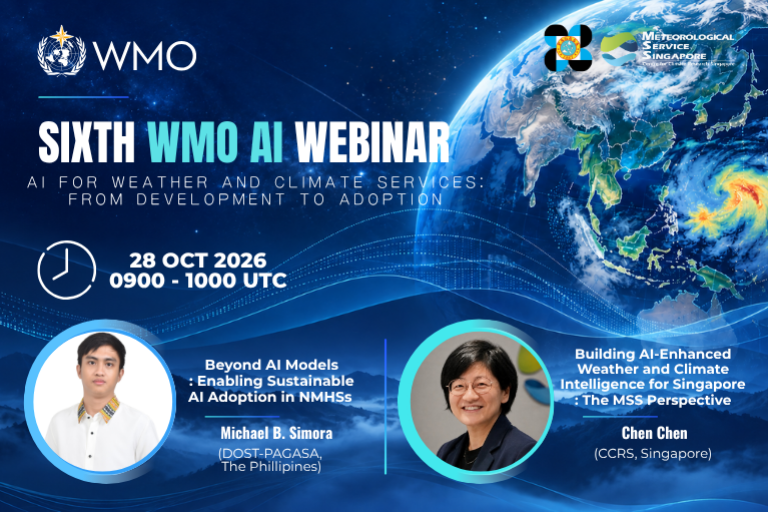
Sixth AI webinar (Registration) for 0900-1000 UTC on 28 October 2026 | |||
| 1 | Beyond AI Models: Enabling Sustainable AI Adoption in NMHSs Abstract: | Michael B. Simora (Weather Specialist , Numerical Modeling Section under the Research & Development and Training Division of the Philippine Atmospheric, Geophysical and Astronomical Services Administration (DOST-PAGASA)) | |
| 2 | Building AI-Enhanced Weather and Climate Intelligence for Singapore: The MSS Perspective Abstract: This presentation showcases MSS’s approach to developing trusted and locally relevant AI capabilities for Singapore and Southeast Asia. It specifically highlights how AI can complement established forecasting methods to address the challenges of tropical regions, while strengthening weather preparedness, climate adaptation, and resilience. | Chen Chen (Head, Numerical Weather Prediction Branch at the Centre for Climate Research Singapore (CCRS), Meteorological Service Singapore (MSS)) | |
| Fifth AI webinar (Registration (ECMWF site)) for 1300-1400 UTC on 24 September 2026 | |||
| 1 | The AI Weather Quest: Framework and Participation over the First Year Abstract: A look back at the Quest’s first year, from its forecasting framework to the global community of participating teams. | Olga Loegel (Innovation Partnerships and Training Specialist, ECMWF) | |
| 2 | Scientific Insights and Rankings Abstract: Key scientific insights from the first year of the Quest, together with the JJA 2026 rankings and overall performance highlights. | Joshua Talib (Scientist on Extended-Range Forecasts, ECMWF) | |
| 3 | Fengshun: Advancing AI-Driven Subseasonal-to-Seasonal Prediction Abstract: The CMAandFDU team has developed the Fengshun family of subseasonal-to-seasonal (S2S) prediction models which participated in the AI Weather Quest: Fengshun, FengshunAdjust, and FengshunHybrid. Fengshun is a lightweight, purely data-driven model that directly predicts weekly probabilistic quintiles of near-surface temperature, precipitation, and mean sea-level pressure. FengshunAdjust is a purely data-driven ensemble model that combines three complementary AI modeling paradigms—Transformer-based, Diffusion-based, and GroupVAE/Mamba-based models—to leverage their respective strengths and improve forecast skill and robustness across variables, regions, and lead times. FengshunHybrid further extends this ensemble strategy by combining three data-driven models with operational dynamical S2S prediction models, thereby exploiting the complementary strengths of AI-based and physics-based forecasting. The Fengshun family has demonstrated strong performance in the AI Weather Quest. FengshunHybrid won the third season of the competition, while in the ongoing fourth season, FengshunAdjust is currently leading the competition, demonstrating the strong potential of purely data-driven ensemble approaches for S2S forecasting. This presentation will introduce the design of the Fengshun family, discuss the complementary strengths of these models, and offer perspectives on the future of operational S2S prediction in the AI era. | Bo Lu (Co-Team Leader, China Meteorological Administration) Zesheng Dou (Developer of the Fengshun Foundation Model, China Meteorological Administration) Yang Zhao (Developer of the Fengshun Ensemble Algorithms, China Meteorological Administration) | |
| 4 | Advancing Subseasonal Forecasting with Machine Learning Abstract: In this presentation, the MicroEnsemble team participating in the AI Weather Quest introduces probabilistic bias correction (PBC), a machine learning framework that substantially reduces systematic error by learning to correct historical probabilistic forecasts. Applied to ECMWF's leading dynamical and AI models, PBC doubles the AI Forecasting System's modest subseasonal skill and improves the operationally-debiased dynamical model on 91% of pressure, 92% of temperature, and 98% of precipitation targets. These probabilistic skill gains translate into more accurate prediction of extreme events and have the potential to improve agricultural planning, energy management, and disaster preparedness in vulnerable communities. | Hannah Guan (Microsoft Research and Harvard College) | |
| 5 | How Far Does Forecast Bias-adjustment Take You? Abstract: The CLINT team (Climate Data Factory, CMCC Foundation) reached the top five of the AI Weather Quest without the AI it set out to build. The skill comes from using and bias-adjusting ECMWF’s ensemble and combining lagged forecasts, an approach that also beats the operational dynamical benchmark. Our deterministic data-driven model, a multi-encoder residual U-Net pre-trained on a 2000-year paleoclimate simulation and fine-tuned on ERA5, entered only in the final two weeks of the competition, where it is used to shift the distribution of the probabilistic dynamical forecast. We give an overview of both approaches and their achievements: the added value obtained from the bias-adjustment and lagged-ensemble route, and the first results from the hybrid approach. | Harilaos Loukos (Founder and CEO, the climate data factory) | |
| 6 | What Comes Next for the AI Weather Quest Abstract: An overview of the Quest’s next phase, including new forecast variables and upcoming opportunities to participate. | Olga Loegel (Innovation Partnerships and Training Specialist, ECMWF) | |
| Fourth AI Webinar for 1200-1300 UTC on 30 July 2026 | |||
| 1 | Artificial Intelligence for Estimating Evaporation in Floating Solar Systems in Chile Abstract: This presentation showcases the application of artificial intelligence to estimate evaporation rates from water bodies hosting floating photovoltaic systems in Chile. Developed as a collaborative effort between the Chilean Meteorological Directorate (DMC), the Ministry of Energy of Chile, and Diego Portales University (UDP), the work demonstrates how AI can enhance evaporation estimates to support floating solar applications. The resulting service is being implemented in Chile's Energy Explorer, strengthening climate services for renewable energy planning and integrated water-energy management. | Mr. Juan Crespo ( Climate Services Expert, Chilean Meteorological Directorate (DMC)) Dr. Camila Vasquez (Renewable Energy Specialist, Ministry of Energy, Chile) Prof. Rodrigo Caceres Rodriguez (Professor, Diego Portales University (UDP), Chile) | presentation(pdf), recording |
| 2 | MLP Correction of Solar Radiation Forecasts from NWP Models in Argentina Abstract: This presentation introduces a machine learning approach based on Multi-Layer Perceptrons (MLP) to improve solar radiation forecasts generated by Numerical Weather Prediction (NWP) models. Developed through collaboration between the Argentine National Meteorological Service (SMN) and the National University of Salta (UNSa), the AI-based correction enhances forecast accuracy, providing more reliable climate services for solar energy generation, power system operations, and renewable energy planning. | Dr. Silvina Righetti (Meteorological Expert, Servicio Meteorológico Nacional (SMN), Argentina) Ms. Cynthia Mastudo (Meteorological Expert, Servicio Meteorológico Nacional (SMN), Argentina) Dr. Germán Salzar (Professor, National University of Salta (UNSa), Argentina) | presentation(pdf), recording |
| 3 | AI-Based Downscaling of Climate Projections for Renewable Energy Atlases in South America Abstract: This presentation introduces a participatory framework for developing national renewable energy atlases that combine observations, climate projections and artificial intelligence to support local decision-making. Building on the WMO Renewable Energy Atlas work in Argentina, Chile, Peru and Ecuador, the approach applies AI-based downscaling to transform global climate projection data into more locally relevant information for wind, solar and hydropower resource assessment. The presentation highlights how the co-development of climate services with NMHSs and energy-sector stakeholders can strengthen long-term renewable energy planning and climate-resilient investment decisions across South America. | Dr. Sara Dal Gesso (Climate Services Expert and WMO Consultant, CEO of AMIGO S.r.l.) | presentation(pdf), recording |
| Third AI Webinar for 0700-0800 UTC on 16 June 2026 - entire recording | |||
| 1 | Operational subseasonal to seasonal (S2S) prediction of drought using ML Downscaling Abstract: Drought has significant impacts on New Zealand’s export-driven economy. In 2022, the Ministry for Primary Industries, in partnership with NIWA, launched a 35-day drought forecast based on the New Zealand Drought Index (NZDI), to mitigate these impacts. | Tristan Meyers (Earth Sciences New Zealand) | presentation(pdf), recording |
| 2 | Integrating AI in Seamless Prediction from Nowcasting to Medium-Range Weather Forecast Abstract: The Hong Kong Observatory (HKO), serving as the WMO Regional Specialized Meteorological Centre (RSMC) for Nowcasting, has been actively developing and operationalizing artificial intelligence (AI) applications across the full spectrum of weather prediction timescales. This presentation outlines HKO's progressive integration of AI and machine learning (ML) techniques — from rainstorm nowcasting to medium-range forecasting — for advancing seamless weather prediction framework. In the nowcasting domain, HKO has continuously enhanced deep learning precipitation forecast models, and has integrated a suite of different deep learning frameworks into the operational SWIRLS nowcasting system. To extend nowcast lead time with broader geographical coverage for supporting WMO Members in southeast Asia, the AI nowcast based on simulated reflectivity of multispectral imagery of geostationary satellite has been implemented in the RSMC for Nowcasting website in December 2025. AI techniques have been widely applied in enhancing short-range to medium-range forecasts. Besides running several AI weather prediction (AIWP) models in-house and using available AIWP data products such as ECMWF AIFS, post-processing techniques have been used to enhance multi-model ensemble products with a view to enhancing location-specific forecasts in Hong Kong. Evaluations demonstrate that the integration of post-processed forecasts from AIWPs with NWPs can further improve the automatic location-specific weather prediction out to 2 weeks ahead. Together, these developments illustrate a paradigm shift towards an integrated AI-augmented seamless prediction chain. Ongoing developments - such as concept of “AI on AI” to further leverage benefits from AI nowcast and medium-range forecast models for improving high-impact weather predictions, as well as challenges ahead will be introduced. | Wai Kin Wong (Hong Kong Observatory) | presentation(pdf), recording |
| Second AI Webinar for 0800-0900 UTC on 27 April 2026 - entire recording | |||
| 0800-08:30 | Advancing Nowcasting with Deep Learning techniques (ANDeL) for West Africa Abstract: Accurate short-term rainfall prediction (0–6 hours lead time) remains a critical challenge across much of Africa, where sparse observational networks and the limitations of conventional numerical weather prediction systems hinder the representation of localized convective processes. The Advancing Nowcasting with Deep Learning techniques (ANDeL) project leverages deep learning architectures (convolutional LSTM and attention-based models) to predict the spatio-temporal evolution of rainfall using multi-source datasets [satellite-derived precipitation (IMERG) and reanalysis (ERA5)]. Initial model training was conducted using IMERG to establish a robust baseline; however, due to its latency (~4 hours), current operational testing employs Rain-over-Africa (RoA) data, which provides low-latency, high spatio-temporal resolution inputs suitable for near-real-time applications. The framework incorporates transfer learning and adaptive fine-tuning to enable efficient deployment across diverse regions, while maintaining a strong operational focus on low-compute environments. | Jeffrey N. A. Aryee (CDAI Lab, Dep't of Meteorology & Climate Science, FPCS, COS, KNUST, Ghana ) | presentation(pdf), recording |
| 08:30-09:00 | WAS-NextGen: An Objective Multi-Method Framework for Seasonal Climate Forecasting in West Africa Abstract: Seasonal climate forecasting in West Africa has traditionally relied on consensus-based methods that lack reproducibility and high-resolution detail. This presentation introduces WAS-NextGen, an automated, multi-method framework that integrates machine-learning-calibrated multi-model ensembles (SV–ML–CMME), statistical–dynamical CCA calibration, lagged-predictor components, and analogue-year methods. Implemented via the open-source Python package wass2s, the system ensures a fully reproducible workflow from data acquisition to probabilistic mapping. | Mandela HOUNGNIBO and Abdou ALI (AGRHYMET RCC-WAS, Niger) | presentation(pdf), recording |
| First AI Webinar for 1300-1400 UTC on 22 January 2026 - entire recording | |||
| 13:00-13:30 | Skilful long-lead nowcasting with NowAlpha in operations Achieving skilful, long-lead precipitation nowcasting remains challenging, particularly when relying on a single observation source. Here we present NowAlpha, an operational radar-only precipitation nowcasting system that extends skilful prediction to 410 minutes. NowAlpha formulates nowcasting as latent-space diffusion video generation: sequences of radar reflectivity are encoded by a continuous visual tokenizer, and a diffusion model generates future latent trajectories that are decoded back to physically plausible reflectivity evolutions. We adopt NVIDIA’s Cosmos tokenizer with pretrained weights, and find that reusing the pretrained tokenizer improves forecast quality compared with training the tokenizer from scratch, indicating that large-scale, general-purpose visual tokenization transfers effectively to the weather domain. In midlatitude regimes, NowAlpha reduces spurious westward tendencies and more faithfully reproduces organized wintertime coastal convective bands and cyclonic precipitation structures. Finally, NowAlpha is validated in operations through a research-to-operations cycle, incorporating iterative feedback from professional forecasters to improve reliability for decision support. | Hyesook Lee (KMA, Republic of Korea) | presentation(pdf), recording |
| 13:30-14:00 | Integration of AI/ML into operational weather and environmental forecasting systems at ECCC Environment and Climate Change Canada (ECCC) is integrating AI/ML into operational weather and environmental forecasting systems. This presentation will summarize the progress on the AI-physics hybrid Global Deterministic Prediction System with Spectral Nudging (GDPS-SN) and describe its path to operationalisation. The presentation will also describe progress made on the AI-based PARADIS weather model and feature other AI/ML projects for weather and environmental forecasting currently underway at ECCC. | Emilia Diaconescu and Stéphane Beauregard (ECCC, Canada) | Presentation(pdf), recording |