

Five Key Takeaways from the TCI Learning Session: Collaboration for Impact – The Role of ACMAD in Strengthening Climate Services Across Africa
The TCI Learning Session highlighted ACMAD's expanding role as a continental leader in strengthening climate services and Early Warnings for All across Africa through coordination, innovation and partnerships. Led by Director General Dr. Ousmane Ndiaye, the session emphasized the importance of continental collaboration to complement national and regional capacities, the transformative potential of artificial intelligence for African forecasting, the growing adoption of impact-based forecasting, and the need for continuous capacity development beyond short-term projects. A recurring message was that stronger climate services depend on sustained partnerships among WMO, regional centres, NMHSs, research institutions and development partners. The discussion underscored ACMAD's evolution into a platform for coordination, technical excellence and innovation, supporting countries to build more resilient and effective weather, climate and early warning services.
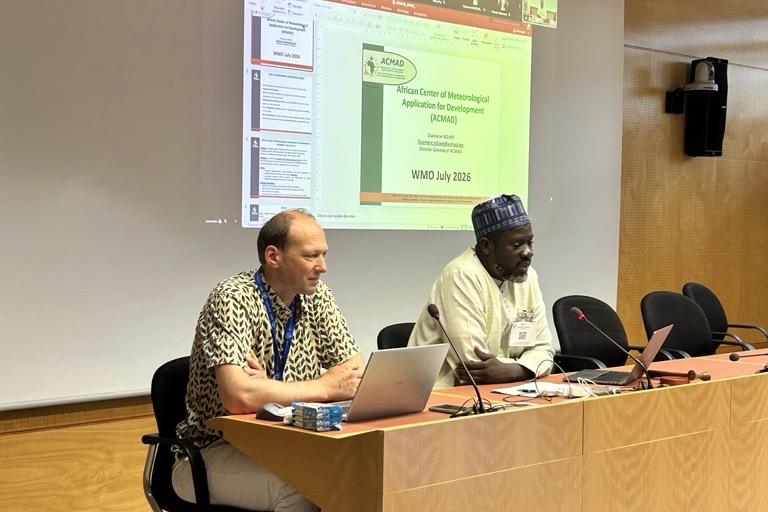
The Technical Coordination Initiative (TCI) Lunch Time Learning Session brought together colleagues from across WMO and partner organizations to explore the evolving role of the African Centre of Meteorological Applications for Development (ACMAD) in strengthening climate services and early warning systems across Africa.
Led by ACMAD Director General Dr. Ousmane Ndiaye, the session showcased ACMAD's strategic vision, operational priorities, and growing role as the continental Regional Climate Centre (RCC). The discussion also highlighted opportunities for deeper collaboration across WMO technical programmes, Regional Specialized Meteorological Centres (RSMCs), Regional Climate Centres (RCCs), development partners and National Meteorological and Hydrological Services (NMHSs).
Below are five key takeaways from the session.
1. Continental coordination is essential to accelerate Early Warnings for All and for effective climate services
Climate hazards increasingly cross-national borders, requiring coordination beyond individual countries and sub-regions. ACMAD's continental mandate enables it to connect regional climate centres, national meteorological and hydrological services and continental institutions such as the African Union Commission to strengthen consistency, knowledge sharing and technical support.
Rather than replacing national or regional capacities, ACMAD aims to complement them by facilitating collaboration, promoting peer learning and ensuring that successful approaches developed in one region can be adapted and scaled across the continent.
This coordinated approach is particularly important as countries work towards implementing the Early Warnings for All initiative and increasing the effectiveness of climate services
2. Artificial Intelligence presents a once-in-a-generation opportunity for Africa
One of the strongest messages from the session was ACMAD's ambition to position Africa as an active contributor not simply a user of Artificial Intelligence for weather and climate services.
AI is lowering the barriers to developing advanced forecasting capabilities, creating new opportunities for African institutions to produce locally relevant models and services without the historical constraints of expensive supercomputing infrastructure.
ACMAD outlined plans to:
- establish AI summer schools for African meteorological professionals;
- build an African community of AI practitioners;
- develop cloud-based computing environments for experimentation;
- foster partnerships with institutions such as ECMWF, universities and research organizations; and
- work towards developing AI models designed specifically for African conditions.
Investing in people skills and innovation will ensure that African institutions remain at the forefront of this technological transformation.
3. Impact-based forecasting is becoming the new standard
Producing forecasts is no longer enough. Increasingly, users need information that explains what weather and climate hazards will mean for people, infrastructure, health, agriculture and livelihoods.
ACMAD highlighted impact-based forecasting as one of its strategic priorities, building on partnerships with ECMWF, the European Union and regional climate centres through initiatives such as CIWA.
The Centre is helping countries move from hazard forecasts to actionable risk information by combining meteorological data with exposure and vulnerability information.
Successful examples already exist across Africa including national heat-health warning systems and ACMAD intends to document these experiences, support peer learning and help countries replicate proven approaches.
4. Sustainable capacity development requires continuous learning not one-off projects
A recurring theme throughout the discussion was sustainability.
ACMAD emphasized that lasting capacity cannot rely solely on short-term projects. Instead, it requires ongoing technical support, on-the-job training, communities of practice and mechanisms for sharing expertise across countries.
The Centre's proposed Regional Training Centre (RTC) designation would formalize its long-standing role in delivering short, demand-driven technical training tailored to the operational needs of NMHSs.
Equally important is ensuring that knowledge generated through projects remains available after funding ends. By developing e-learning materials, documenting good practices and creating continental repositories of expertise, ACMAD aims to preserve and expand the value of investments made by partners.
5. Strong partnerships are the foundation for stronger climate services
Perhaps the clearest takeaway from the session was that no single institution can deliver resilient climate services alone.
Throughout the discussion, ACMAD demonstrated how collaboration underpins its work partnering with WMO, RCCs, RSMCs, the African Union Commission, humanitarian organizations, research institutions and development partners.
The Centre views itself as a continental convener, helping coordinate technical expertise, mobilize resources and ensure that investments align with African priorities.
For WMO technical programmes and partners, the session reinforced the importance of working through existing regional institutions, building complementary capacities and leveraging comparative advantages to maximize impact.
Looking Ahead
The session illustrated how ACMAD is evolving beyond its traditional role as a Regional Climate Centre into a continental platform for innovation, coordination and capacity development.
As Africa faces increasing climate risks, emerging technologies such as AI, growing demand for impact-based forecasting and the continued rollout of Early Warnings for All and continues effort to improve climate services present significant opportunities. Realizing these opportunities will depend on strong partnerships, sustained investment and coordinated action across the climate, hydrology and meteorology community.
The Technical Coordination Initiative provides an important platform to foster these conversations, connect expertise across programmes and strengthen collaboration that ultimately supports Members in delivering more effective weather, climate and early warning services.