Advancing Research to Operations: Highlights from the SERA Workshop in Hong Kong
WWRP/SERA Regional Workshop | Hong Kong SAR | 10 October 2026
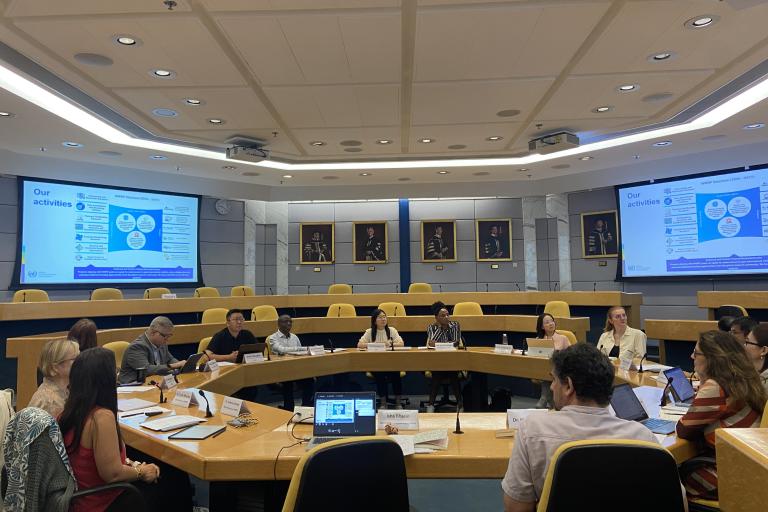
The World Weather Research Programme’s (WWRP) Societal and Economic Research Applications (SERA) Working Group workshop, held in Hong Kong SAR on 10 October 2026, brought regional partners together to strengthen collaboration and advance the translation of research into services that deliver societal benefits.
Representatives from 4 projects, namely SEPRESS, HI-Heat, HI-Rain and Urban-PREDICT shared their activities, and opportunities for engagement with SERA. Discussions focused on 3 priorities: strengthening collaboration, AI-assisted services, and demonstrating the societal value of weather and climate services.
Three opportunities for advancing research to operations
1. Strengthen regional collaboration around shared challenges
The four projects operate in different geographical and institutional contexts but face common challenges: connecting scientific information with decision-making, identifying relevant users, evaluating services and building partnerships that support operational uptake. Examples illustrate both progress and opportunity. SEPRESS releases monthly outlooks for key climatic variables and assessments of disaster trends in China and globally. HI-Rain produces monsoon and winter outlooks for the Hindu Kush Himalayan region in collaboration with the International Centre for Integrated Mountain Development (ICIMOD) and monthly bulletins distributed through WeChat. HI-Heat is developing models that link meteorological conditions with health data, including hospital visits, to investigate heat-related risks. Urban-PREDICT supports capacity-building in high-resolution modelling and is considering how to assess the usefulness of its outputs. Across the projects, stronger engagement with operational agencies, policymakers, and other potential users can connect these scientific activities with practical needs.
The Opportunity: A regional connector that can bring projects around shared problems or specific research questions, providing access to complementary expertise and strengthening relationships with operational institutions.
2. Embed interdisciplinary research from the beginning
A recurring concern was the limited involvement of social scientists in weather/climate research projects. Participants indicated that funding calls often prioritised technical outputs, while institutions may not recognise the time and effort required to build sustainable interdisciplinary partnerships. Nonetheless, understanding how weather information is interpreted, trusted, and used is integral to effective service development. Physical and social scientists, operational professionals, and users need opportunities to shape research questions together. Participants reflected on a shift from the traditional “last mile” idea of weather communication toward a “first mile” approach, in which societal needs help shape research priorities and product development from the outset. This requires two-way learning: social scientists need to understand the assumptions and limitations of physical models, while physical scientists benefit from social research methods and insights into human behaviour and decision-making.
The Opportunity: Promote interdisciplinary project design, identify relevant social science expertise across the regional research community, and encourage funding and evaluation approaches that recognise meaningful collaboration.
3. Develop AI-assisted services responsibly
AI is already supporting several areas of weather and climate research, with potential applications ranging from higher-resolution information derived from coarser datasets to improved analysis and warning services. Yet technical performance alone cannot determine whether an AI application is appropriate, trustworthy, or beneficial. Participants raised questions about trust, uncertainty, ethics, equity, cybersecurity, and environmental costs. They also emphasised the importance of retaining human judgement and critical thinking, particularly when AI-supported information informs decisions affecting public safety.
An example from Brazil illustrated the potential for AI-assisted analysis of operational warning messages. Work examining approximately 200,000 messages from 2020–2026 considers language clarity, recommended actions, hazard and location identification, consistency between warning severity and protective guidance, and compliance with national requirements. Human review remains essential. Crucially, analysing the content of a warning cannot establish on its own whether people understood it, trusted it or were able to act.
The Opportunity: Start with the needs of users and operational services, then determine where AI can add value. SERA could facilitate research on trust, uncertainty communication, fairness and inclusion, and the evaluation of how people understand and use AI-supported forecasts and warnings.
From Opportunities to regional action
The workshop provides a basis for WWRP/SERA to move from discussion to focused collaboration. 3 actions stand out:
- Connect projects and expertise: Identify complementary capabilities and strengthen institutional partnerships across the region.
- Evaluate what matters: Promote approaches that assess whether services support better understanding, decisions, preparedness and responses, not only technical performance.
- Advance responsible AI: Explore trust, uncertainty, ethics, inclusion and human oversight in AI-assisted weather and warning services.
A Shared Agenda for Impact
The workshop reinforced the importance of moving beyond the production of increasingly sophisticated forecasts towards services that respond to societal needs. Achieving this requires sustained regional partnerships, meaningful interdisciplinary research, and evaluation that demonstrates whether scientific advances make a difference in practice. SERA can help drive this transition by connecting research, operational expertise and social science around shared challenges.
Abbreviations:
- HI-Rain: Formation Mechanism and Sub-seasonal Dynamic Prediction of Extreme Rainfall in the Southern Slopes of the Himalayan Region
- HI-Heat: Analysis of the Causes of Heat Waves and Construction of an Intelligent Seasonal Prediction Model in the Southern Slopes of the Central and Western Himalayas
- SEPRESS: Seamless Prediction and Services for Sustainable Natural and Built Environments
- WWRP Flagship Project: Urban-PREDICT
- Region:
- Region II: Asia