

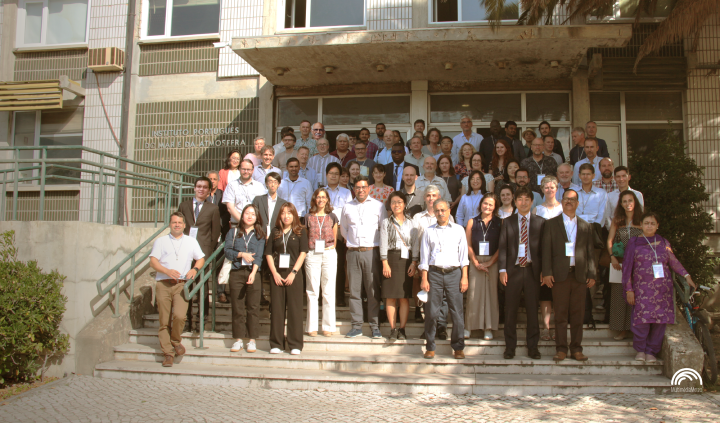
Third WMO Workshop on Operational Climate Prediction


Lisbon, Portugal
Background
The WMO Workshops on Operational Climate Prediction (OCP) started in 2015. They serve operational and research communities by reviewing progress in operational practices and understanding of climate prediction and sharing experience as we develop state-of-the-art operational climate prediction products from sub-seasonal to decadal time scales for WMO Members and partner organizations.
More information on the previous workshops can be found via these links: OCP-1, OCP-2. The 3rd workshop aims to continue the dialogue between operational climate prediction centres and to strengthen interaction and partnerships between the operational and research communities, with particular emphasis on regional activities.
OCP-3 is to be held in person from 20 to 22 September 2022 in Lisbon, Portugal, hosted by the Instituto Português do Mar e da Atmosfera (IPMA).
The workshop is jointly organized by WMO Infrastructure Commission and Services Commission in collaboration with WMO Research Board
Session topics
- Current status of operational activities in sub-seasonal, seasonal and decadal time scales
- Cascading climate prediction from global to regional to local scales
- Research developments related to climate prediction on sub-seasonal to decadal timescales
- Understanding user requirements
- Tailoring of climate prediction products and information to meet user needs on sub-seasonal to decadal timescales
- Use of ensemble approaches to effectively produce, deliver and communicate probabilistic sub-seasonal, seasonal and decadal climate predictions
Documents
- Agenda
- Abstract volume
- Final report
- Key subjects/questions to be discussed
- Information note
- Code of conduct
Invited Talks
- How operational prediction informs sub-seasonal to seasonal research, Benjamin Kirtman (University of Miami, USA)
- Research-to-operations knowledge transfer in climate prediction, Francisco Doblas Reyes (BSC, Spain)
Current status of operational activities in sub-seasonal, seasonal and decadal time scales
- Introduction to GDPFS and its role in operational climate prediction, Arun Kumar (NOAA/CPC, USA)
- Good practices for operational climate prediction, Caio Coelho (CPTEC/INPE, Brazil)
- Overview of current sub-seasonal prediction activities, Andrea Molod (NASA, USA)
- Overview of current seasonal prediction activities, Anca Brookshaw (ECMWF, UK)
- Overview of current annual to decadal prediction activities, Melissa Seabrook (UKMO, UK)
Cascading climate prediction from global to regional to local scales
- Main outcomes of the regional specific guidance for operational production of objective seasonal forecasts, Ernesto Rodriguez Camino (AEMET, Spain)
- East Africa Seasonal Forecasting: A Journey, Stefan Lines (UKMO, UK)
- Status of Pacific RCC-Network (in demonstration phase) climate prediction products and services, Simon McGree (BOM, Australia)
- ASEAN Climate Outlook Forum: journeying towards next-generation RCOF, Thea Turkington (MSS, Singapore)
- Specialized climate forecast products developed by North Eurasian Climate Centre (NEACC) for sectoral users, Valentina Khan (ROSHYDROMET, Russian Federation)
Research developments related to climate prediction on sub-seasonal to decadal timescales
- Sources of Predictability across timescales, Doug Smith (UKMO, UK)
- Subseasonal Forecasts in the Northern Hemisphere Midlatitudes, Emanuel Dutra (IPMA, Portugal)
- Seasonal prediction of the Indian summer monsoon, Suryachandra Rao Anguluri (IITM, India)
- Tropical Cyclone Activity in CMCC SPS Seasonal Forecast, Zhiqi Yang (CMCC, Italy)
- Prospects for Multiyear Climate Forecasts with Useful Skill, Matthew Newman (NOAA/PSL, USA)
- Decadal predictions: recent advances, remaining challenges and open research questions, Panos Athanasiadis (CMCC, Italy)
Understanding user requirements
- Climate service user engagement, Chris Hewitt (UKMO, UK)
- Climate information for climate services in the context of adaptation and resilience, Suraje Dessai (University of Leeds, UK)
- The adaptation of climate forecast information to specific users: experience with the rice sector of northeastern Argentina, María Mercedes Poggi (SMN, Argentina)
- Challenges and requirements of NMHSs in developing countries, Alice Soares (Portugal)
- The complexity of user engagement in climate service delivery in the Greater Horn of Africa: Power, governance and culture, Linda Ogallo (ICPAC, Kenya)
- An AI/ML based S2S forecasting tool for Climate Services, Nachiketa Acharya (CIRES, NOAA)
Tailoring of climate prediction products and information to meet user needs on sub-seasonal to decadal timescales
- Sub-seasonal and seasonal forecasts for agriculture: a user-centered approach, Debbie Hudson (BOM, Australia)
- CFS-Based Subseasonal Scale Ensemble Prediction System for South Asia: Development to Societal Applications, Atul Kumar Sahai (IITM, India)
- Provision of climate information services to sustain farmers decision making in senegalese peanut basin, Ousmane Ndiaye (ANACIM, Senegal)
- Seasonal and sub-seasonal rainfall forecasts tailored for electricity production in Fiji, Arieta Baleisolomone (Fiji Met Service, Fiji)
- H2020 CLINT - An AI-Enhanced operational demonstrator of sub-seasonal and seasonal forecasting of detection and attribution of heat waves and warm nights, Harilaos Loukos (Climate Data Factory, France)
- How decadal predictions entered the climate services arena: an example from the agriculture sector, Balakrishnan Solaraju-Murali (BSC, Spain)
Use of ensemble approaches to effectively produce, deliver and communicate probabilistic sub-seasonal, seasonal and decadal climate predictions
- A user-oriented, seamless climate service based on subseasonal, seasonal and decadal predictions: the DWD climate predictions website, Andreas Paxian (DWD, Germany)
- UNprecedented Simulated Extremes using ENsembles: worst case scenarios from seasonal to decadal prediction ensembles, Adam Scaife (UKMO, UK)
- Designing an optimal strategy for GMAO S2S ensemble forecast, Anna Borovikov (NASA, USA)
- Real-time multi-model sub-seasonal calibrated probabilistic forecasts of precipitation and temperature based on SubX ensemble prediction systems, Andrew Robertson (IRI, USA)
Wrap-up and way forward
Format
Posters are expected to be displayed in the workshop venue throughout the 3-day workshop. The recommended size for posters is A1 (841 x 594 mm or 33.1 x 23.4 inches) in landscape orientation. Each poster will be given a time slot of 3 minutes in plenary session to orally introduce the poster, please refer to the programme and agenda for more details. Participants presenting posters are invited to prepare one single slide for each poster, provided to the Secretariat in advance.
Working language of this workshop is English.
OCP-3 is open to the operational and research communities. There is no registration fee. WMO has limited resources to support the travel and per diem of invited participants. All other participants will need to cover their own travel costs.
Virtual participation
The workshop will be conducted primarily as a face-to-face event; however, the plenary sessions will also be made available via Zoom. Please refer to the programme and agenda for more details on sessions available via Zoom.
Contact
For further information, please contact WMO Earth System Prediction Division at dpfsmail wmo [dot] int (dpfsmail[at]wmo[dot]int)
Organizing committee
Jean-Pierre Ceron (France; ET-CSISO1, WMO), Caio Coelho (CPTEC, Brazil; co-chair of ET-OCPS2, WMO), Kristina Fröhlich (DWD, Germany; ET-OCPS2, WMO), Rupa Kumar Kolli, (IITM, India; co-chair of ET-CSISO1, WMO), Arun Kumar (CPC, NWS, NOAA, USA; co-chair of ET-OCPS2, WMO), William Merryfield (ECCC, Canada; WGSIP3), Andrea Molod (NASA, USA; S2S4), Roger Pulwarty (NOAA, USA; co-chair of ET-CSISO1, WMO), Adam Scaife (Met Office, UK; ET-CSISO1, WMO)
WMO Secretariat: Nico Caltabiano (World Climate Research Division), Yuki Honda (Earth System Prediction Division), Wilfran Moufouma Okia (Regional Climate Prediction Services Division) and Munehiko Yamaguchi (World Weather Research Division)
1) ET-CSISO: Expert Team on Climate Services Information System Operations
2) ET-OCPS: Expert Team on Operational Climate Prediction System
3) WGSIP: WCRP Working Group on Subseasonal to Interdecadal Prediction
4) S2S: WWRP/WCRP Subseasonal-to-Seasonal Prediction Project