

Planning and Budgeting
Vision
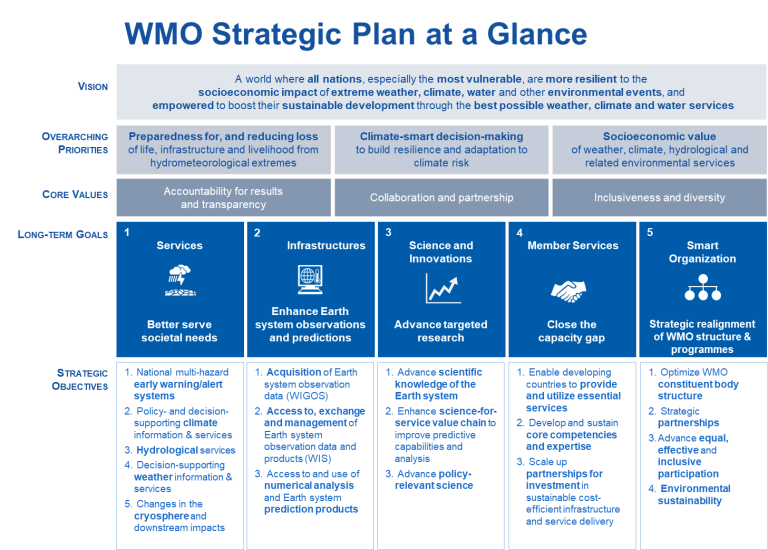
By 2030, we see a world where all nations, especially the most vulnerable, are more resilient to the socioeconomic consequences of extreme weather, climate, water and other environmental events; and underpin their sustainable development through the best possible services, whether over land, at sea or in the air.
Mission
WMO’s mission is outlined in Article 2 of the WMO Convention as to facilitate worldwide cooperation on monitoring and predicting changes in weather, climate, water and other environmental conditions through the exchange of data, information and services, standardization, application, research and training.
Core values
- Accountability for results and transparency
- Collaboration and partnership
- Inclusiveness and diversity
The Process
WMO’s strategic and operational planning is built on the results-based management concept established by the fifteenth World Meteorological Congress as fundamental for managing the planning, budgeting, implementation, monitoring and reporting of WMO’s programmatic work.
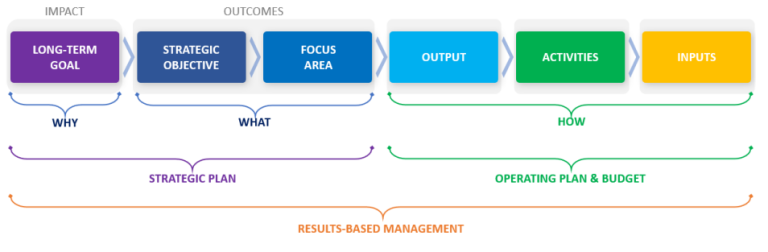
The WMO planning process is based on three interlinked components:
- The WMO Strategic Plan 2024-2027 articulates the high-level vision, mission, core values and overarching priorities of the Organization. It outlines a set of long-term goals and strategic objectives with a 2030 horizon as well as identifies areas of focus for the 2024-2027 financial period.
- The WMO Operating Plan 2024-2027 and the WMO Operating Plan 2026-2027 translate the strategy into specific actions by defining outputs to be delivered (i.e. lower-level results) and annual milestones to be achieved. The Operating Plan also lists planned activities, indicates the resources available, and outlines performance indicators intended to measure progress in achieving the strategic objectives.
- The WMO Results-based Budget (maximum expenditure approved by Congress) identifies resources for implementation of the Strategic Plan, including the functioning of constituent bodies and the Secretariat.
Risk management and quality assurance are embedded in both strategic and operational planning, as well as in monitoring and evaluation processes.
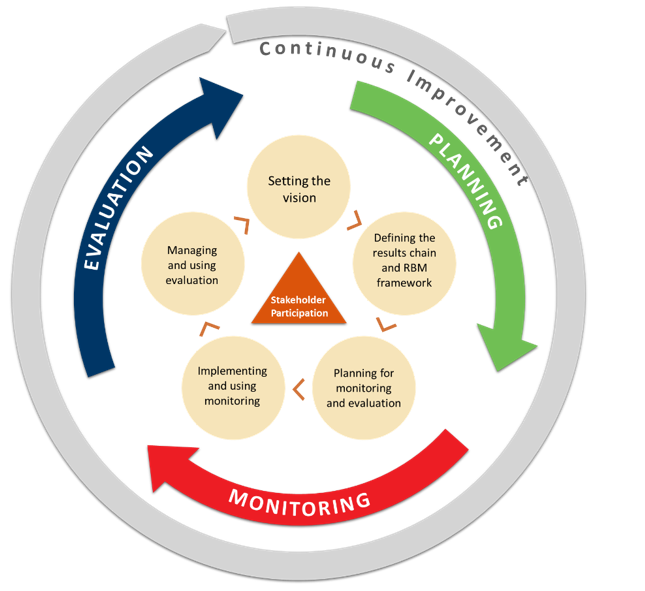
These elements are expected to contribute to achieving the long-term results defined in the WMO Strategic Plan, with the resources provided under the WMO Results-based Budget – Maximum expenditure approved by Congress, and the in-kind support of technical commissions and regional associations.
Results Framework and Key Performance Indicators
- Goal 1: BETTER SERVE SOCIETAL NEEDS: delivering, authoritative, accessible, user-oriented and fit-for-purpose information and services
- Goal 2: ENHANCE EARTH SYSTEM OBSERVATIONS AND PREDICTIONS: strengthening the technical foundation for the future
- Goal 3: ADVANCE TARGETED RESEARCH: leveraging leadership in science to improve understanding of the Earth system for enhanced services
- Goal 4: CLOSE THE CAPACITY GAP: enhancing service delivery capacity of developing countries to ensure availability of essential information and services needed by governments, economic sectors and citizens
- Goal 5: GOOD GOVERNANCE: for effective policy- and decision-making
Results-Based Budget Development
The Results-Based Budget is developed using two different time horizons. The four-year Maximum Expenditures, which is approved by Congress, sets the limits for expenditure by appropriation part for the four-year financial period. The Biennial Budgets, two per financial period, provide the authorization for expenditure by the Secretariat during each of the biennia and forms the basis for appropriations that are funded by assessed contributions.
The Maximum Expenditure document is developed based on the relevant WMO Strategic Plan as elaborated in the related quadrennial WMO Operating Plan. The Secretary-General and their team identify the needed resources, including both staff and non-staff, required to deliver the quadrennial Operating Plan. The estimates of required resources are aggregated, consolidated, reviewed and approved internally and are then sent to Congress for formal approval after preliminary review by the Executive Council.
The Biennial Budgets are developed by the Secretary-General, considering the operating environment and Member priorities at the time of their development, all within the context of the Strategic Plan and based upon the limits imposed and guidance provided in the Maximum Expenditure document. The estimates of resources to be appropriated are aggregated, consolidated, reviewed and approved internally and are then sent to the Executive Council for formal approval. The approval by the Executive Council is the authorization for the Secretary-General to invoice Members and to incur expenditures.
Consultative Process
The following are the key steps in the development of the Maximum Expenditures, including which constituent bodies are involved and the normal timing:
| Step | Constituent Body or Secretariat | Timing |
| Preparation of the process for and elements of the maximum expenditures (setting scenarios for potential expenditure levels) | FINAC Executive Council | June FINAC/EC in year prior to Congress |
| Review of draft Strategic Plan by Executive Council | FINAC Executive Council (following pre-review by PAC) | June FINAC/EC in year prior to Congress |
| Secretariat Preparation of quadrennial Strategic Plan, Operating Plan and Maximum Expenditures | Secretariat | June-November in year prior to Congress |
| Publishing of quadrennial Strategic Plan, Operating Plan and Maximum Expenditures | Secretariat | December in year prior to Congress |
| Review of Secretary-General’s proposed Maximum Expenditures | FINAC Executive Council | First quarter in year of Congress |
| Revisions to Maximum Expenditures by Secretariat | Secretariat | First quarter in year of Congress |
| Review and approval of Maximum Expenditures | FINAC Congress | At Congress session |
The following are the key steps in the development of the Biennial Budget, including which constituent bodies are involved and the normal timing:
| Step | Constituent Body | Timing |
| Preparation of the biennial budget based upon the priorities and considerations in the approved Maximum Expenditures | Secretariat | Jan – April in year of Executive Council considering budget |
| Review of proposed biennial budget | FINAC | Immediately prior to Executive Council considering budget |
| Revisions to proposed biennial budget | Secretariat | Immediately after consideration by FINAC |
| Review and approval of biennial budget | Executive Council | At June Executive Council session in alternate years |